Theme: “We are made of star-stuff”
Deadline: Friday, February 27th 2026
"The Universe is within us. We are made of star stuff." - Carl Sagan
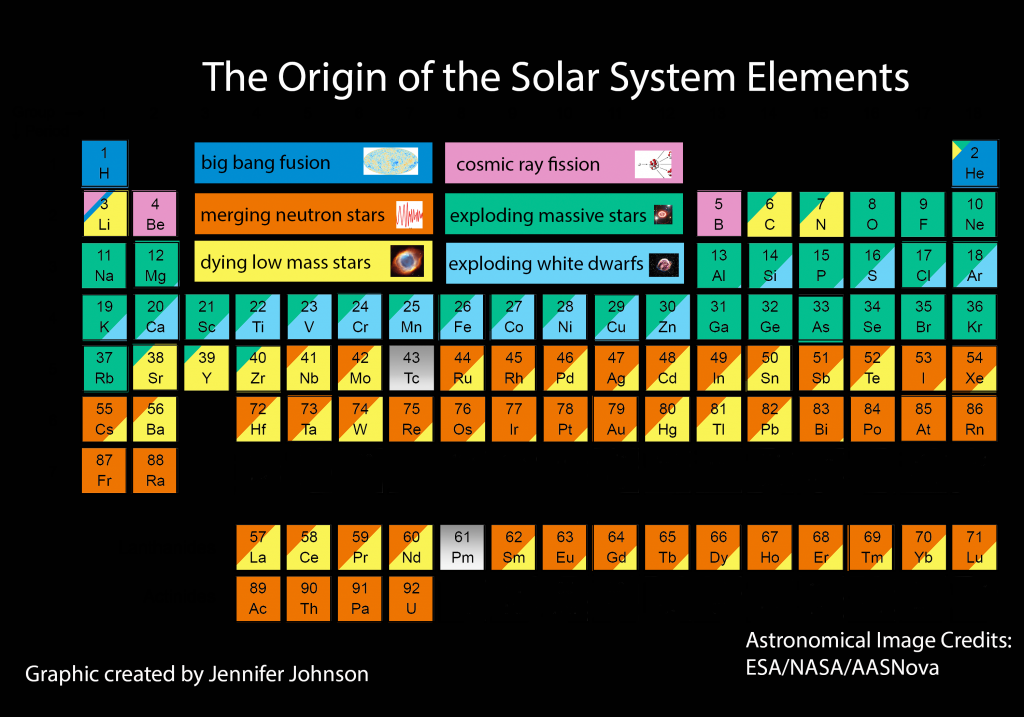
This famous quote from Carl Sagan is not hyperbole, but reality. The chemical elements that form the building blocks of our bodies are formed only through nuclear fusion in the hearts of stars. Everything around us once started as hydrogen and helium gas that cooled and condensed into stars. Over millions of years, those stars formed heavier elements called metals in their cores. Then, once they've exhausted their fuel, the most massive stars explode in a brilliant supernova and spread those metals in their core out into the universe. Those metals then join the hydrogen and helium gas to condense once more into more stars, but also into rocks and ice that form planets and eventually form living organisms like plants and animals. Every molecule in our body and our surroundings contains elements that were once inside the very heart of a star.
Judging
Artwork submitted to the contest will be judged on the artistic skill demonstrated in the work as well as creative interpretations of the theme. Members of the Astronomy and Astrophysics Department will judge the work.
Only one work per student will be judged. If you submit multiple, please indicate which one you would like to be considered for prizes.
Students may include a description of their work and its connection to "We are made of star-stuff" upon submission. This is particularly encouraged for abstract pieces.
First, second, and third place prizes will be awarded within each age group.
Age Groups
-
Elementary (Grades K-5)
-
Middle School (Grades 6-8)
-
High School (Grades 9-12)
Prizes Per Age Group
-
Grand Prize $100
-
First Runner-up $50
-
Second Runner-up $25
An additional award of $100 will be given to the UChicago Astronomy & Astrophysics Department favorite, independent of age group.
Submission Requirements
-
One submission per student.
-
Drawings/paintings will be accepted. Digital works can be printed out, please contact the art contest organizers if you cannot print the work yourself. Due to storage constraints, sculptures will not be accepted.
-
Submissions must be dropped off in Eckhardt Research Building (5640 S Ellis Ave, Chicago, 60637), in the drop-off bin outside Room 599, between 8:30 am - 5 pm.
-
All submissions must have an attached submission form (linked above) in order to be considered.
-
Note: Because we are not affiliated with Chicago Public Schools we cannot send emails to children’s CPS email accounts. Please include the email of a parent/guardian or a teacher for each submission, NOT the child’s CPS email.
-
For questions about dropoff, please contact the organizers at southsideastroart@gmail.com
Winners will be notified TBA. A reception for all participants will be hosted at the Eckhardt Research Building, Room 161, date TBD.
More information for Teachers, Guardians, and Parents
After the Big Bang, the universe was filled with just protons and electrons, which came together to form hydrogen and helium. All other elements were formed via fusion in the hearts of stars. Stars are mostly made of hydrogen. At the beginning of its life, a star will fuse together hydrogen into helium, a process that releases a lot of light and heat, and causes stars to “burn.” Later in their lifetimes, if a star is big enough, it may begin to fuse helium into carbon, then carbon into oxygen, then oxygen to neon, all the way up to iron. When a star can no longer fuse, it will collapse and explode in a process known as a supernova—an explosion so energetic that it can release 10^44 Joules of energy, roughly equivalent to 10^28 Megatons of TNT or enough energy to power the world for about a septillion (a trillion trillion) years! Every element past iron is formed during these forceful events.
There are actually many types of stars, which differ based on their mass and composition: yellow giants (like our star), red giants, red supergiants, blue supergiants, white dwarfs. It’s not surprising then that there are actually many types of supernovae that can happen which produce different elements when they occur. However, death is not the end for the elements in our stars: after they “go supernova” they form clouds of gas called nebulae… over time, these clouds can reform into stars which themselves will grow, burn and explode. We think that the gas in a star like our sun has been through this process maybe a thousand times! Our star is still mostly hydrogen, and only 1% of it is heavier elements.
Our sun and the Earth and all of the planets in our solar system formed from the same cloud of enriched gas that passed through countless numbers of stars. All the oxygen in the water on Earth formed from stars; all the nitrogen in our atmosphere too; our ancestors, the first lifeforms in the oceans of Earth self-assembled from carbon originally forged in the heart of some ancient star. Then, we are all star-stuff, as Carl Sagan said, and so is the food you eat, your pet, the homework you have to do, and everything else you can see. Most everything that makes our lives so rich and textured are formed from the same hundred or so elements that have been recycled over and over, first by stars, then by planets, then by generations of plants and animals before you. Long after we are gone, once our sun explodes, the cloud of gas will swirl around and eventually form a new star, maybe with new planets, maybe with new life, maybe new people who will make new, wonderful art.
Resources:
[3] https://www.nhm.ac.uk/discover/are-we-really-made-of-stardust.html
[4] https://rainman.astro.illinois.edu/ddr/stellar/
[5] https://spaceplace.nasa.gov/menu/play/